Friday, May 10, 2013

Sweden halts deportations to Eritrea

Sweden have stopped deporting people to Eritrea as the Migration Board (Migrationsverket) reevaluates its policy regarding asylum applicants from the east African country.

The move comes following an email sent on Thursday to all police authorities in Sweden to not forcibly deport people to Eritrea.

"From what I understand the Migration Board is planning to stop these type of forced deportations. That's why we've made this decision," Sören Clerton, head of the border control unit with Sweden's National Bureau of Investigation (NBI) told the TT news agency.

Clerton added that police have had talks with both the Migration Board and human rights group Amnesty about the situation in Eritrea.

According to Amnesty, Sweden is the only country in Europe that has continued to deport people to Eritrea in recent years.

"It's a real problem that Sweden has made a faulty assessment of the risks in Eritrea," Madelaine Seidlitz, a lawyer with Amnesty in Sweden, told TT.

In an Amnesty report due to be published later in May, the human rights group argues that refugees are viewed as criminals in Eritrea.

"Countless numbers of people have been imprisoned arbitrarily after having been arrested when they try to cross the border," Amnesty writes, adding that people can be held for up to three years and that their family members can also be arrested.

Nearly all Eritreans who apply are granted asylum in Sweden, the TT news agency reports. The approval rate so far this year is 96 percent. But in some cases, applications are denied and people are deported back to Eritrea. In 2012, 19 people were deported and so far this year four people have been sent back, two of whom were forcibly deported.

Amnesty claims that Eritreans who seek asylum abroad are seen as traitors by the regime and risk being arrested and tortured upon their return.

"We're looking at that question: is the fact that someone sought asylum in and of itself enough for them to be harmed? Hopefully, I'll be able to have a ruling on the matter early next week," Fredrik Beijer, acting general counsel with the Migration Board, told TT.

In the meantime, no one will be deported to Eritrea

Tuesday, May 7, 2013

Eritrean mothers and children released from Israeli prison


The Israeli Ministry of Interior ordered the release of all Eritrean mothers and children detained under the Anti-Infiltration Law for long months Nine Eritrean female asylum seekers with their ten children were released last night after the Hotline for Migrant Workers petitioned for their release last week once more. The release was made possible by a precedent ruling of the Beer Sheva District Court in an appeal of the Hotline for Migrant Workers last week. In the ruling, Judge Alon declared that being a minor can be considered a "special humanitarian ground" for release from detention, even under the Anti-Infiltration Law. The Hotline for Migrant Workers commends this release after a long period during which the NGO called and petitioned for the release of children from detention. Adi Lerner, the Crisis Intervention Center Coordinator at the Hotline for Migrant Workers said: "We commend the decision of the Ministry of Interior, yet we are puzzled why there was a need to detain such young children (from the age of 18 months to seven) for such a long period of time before noticing what is crystal clear: children should not be behind bars regardless of their origin. We need to remember that even now, six families with 14 children are still detained in the Saharonim internment camp. We call the Ministry of Interior to release them as well." According to the Israeli law, a person is considered
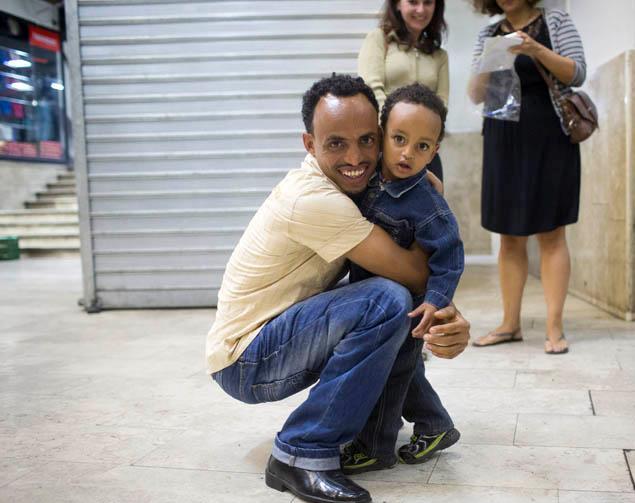
Eritrean father meets his son after years
a minor until the age of 18,
but in its responses to court, the State refers to detained children only under the age of 10 as minors. The Hotline for Migrant Workers is aware of a 14-year-old South Sudanese minor who was separated from his mother and younger siblings and is detained separately from them in the men's section, in violation of regulations that prohibit the jailing of minors alongside detainees over the age of 18. We have no knowledge about how many more children between the ages of 10-18 are still detained. Until now, the State claimed that since the Anti-Infiltration Law states that unaccompanied minors can be released from detention, it necessarily means that minors accompanied by their parents should remain in detention. In his verdict last week, Judge Alon stated that releasing minors on humanitarian grounds should be a matter of discretion regardless of whether the minor is accompanied or not. He added that "remaining in indefinite detention will undoubtedly cause significant harm the minors' social and mental development." As a result of this verdict and a new request submitted by the Hotline for Migrant Workers, the Ministry of Interior released the nine mothers and their children last night. The women and children were released at 6:30 pm without giving any notice to the Hotline or their families in Israel.

Toronto police offer $50,000 reward in brutal murder of Nighisti Semret

Toronto police putting up signs of  victim Nighisti Semret in cabbagetown
Armed with new information, Toronto Police are once again seeking the public’s assistance in tracking down the man who killed Nighisti Semret and are now offering up to $50,000 for information leading to his arrest. 


The 55-year-old Semret was stabbed to death in an alleyway off Ontario Street near Carlton and Parliament streets at roughly 7 a.m. on Oct. 23, 2012. She was returning home from her job at the Delta Chelsea Hotel when the attack took place.
A suspect in the case was captured on video but his face was obscured and none of the leads police were given resulted in an arrest.
Now, police are looking to use DNA evidence to track down the killer.
“Investigators believe the attacker injured himself or was injured during the attack,” said Toronto Police constable Wendy Drummond.
According to police, the DNA of a male was found under Semret’s fingernails, on Semret’s black canvas bag and blood found at the scene. Police believe the attacker may have cut himself with his own knife during the attack.
The DNA samples all belong to the same individual.
Police are now looking for a male who sustained unexplained injuries to his hand or arm around the time of the attack.
“He potentially did not seek medical attention, but if he did, that would be valuable information,” Drummond said. “The way the blood came off the suspect’s hand suggests the injury was more than minor.”
Police have posted a $50,000 reward for information leading to the identification, arrest and conviction of the suspect.
Anyone with information is asked to contact police at 416-808-7400, Crime Stoppers anonymously at 416-222-8477 or online at www.torontopolice.on.ca/rewards

Thursday, May 2, 2013

UN Special Rapporteur On Human Rights in Eritrea Begins Official Tour

Ms. Beedwantee Keetharuth, UN Special Rapporteur on the human rights situation in Eritrea
The United Nations special rapporteur on the human rights situation in Eritrea, Sheila B. Keetharuth, is due to begin on Tuesday (April 30th) a 10-day fact-finding mission to Ethiopia and Djibouti to collect first-hand information on the human rights situation inside their country, Eritrea. During her mission, Keetharuth will interview Eritrean refugees residing in various locations in Ethiopia and Eritrea to assess allegations of widespread and systematic violations of human rights in Eritrea contained in a number of disturbing reports received from different sources.
The visit comes as the regime in Asmara has rejected her appointment, describing it as politically motivated and blocked her from entering the country. Following this, Keetharuth, in a statement issued by The Office of the United Nations High Commissioner for Human Rights (OHCHR), said she "will engage with all others concerned by human rights in Eritrea, including those who consider themselves to be victims of alleged human rights violations, human rights defenders and other civil society actors" due to "a lack of access to Eritrea".
The10-day fact-finding mission to Ethiopia and Djibouti would be her first field mission since her appointment in November 2012 with a one-year mandate. In her one-year mandate, she is tasked with carrying out investigations on the human rights situation inside Eritrea and reporting her findings to the UN Human Rights Council (UNHRC). Her findings will be published in her first report to the UNHRC in June.

Wednesday, May 1, 2013

Ethiopia accused Eritrea refusing to engage in peace talks

Ethiopian Minister Tedros Adhanom with  the UN Secretary-General Ban Ki-moon
The Ethiopian government on Monday has reiterated its readiness to hold peace talks with Eritrea to resolve their decades-long border dispute
During his meeting with the United Nations Secretary-General Ban Ki-moon in New York, the Ethiopian Minister of foreign Affairs Tedros Adhanom accused the Eritrean government of refusing to engage in peace talks.
Adhanom said his country is ready to sit down for direct negotiations with Eritrea without any preconditions regarding to level, time or venue.
But the Ethiopian top diplomat stressed "the belligerent party opposed to these talks has always been the Eritrean side".
According to the ministry of foreign Affairs, Tedros expressed solidarity with the people of Eritrea whom he said are continuously suffering due the regime's "brutality and obstinacy to peace".
Ethiopia and Eritrea fought a border war in 1998-2000 that has killed an estimated 70,000 people.
The two East African adversaries remain at loggerheads since the disputed key town of Badme had been awarded to Eritrea by an international border commission.
Ethiopia's current leader Hailemariam Desalegn, who assumed power shortly after longtime ruler Meles Zenawi died in August said last year that he was willing to hold face-to-face talks with Eritrean president Isaias Afwerki, even if he had to travel to the Asmara.
However, the Eritrean government has yet to respond to the offer.
Asmara has in the past said that Ethiopia should first withdraw its troops from the flashpoint border town of Badme before resuming to peace talks.